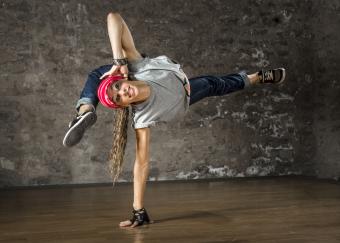
Compared to many other dance forms, hip hop has a relatively short history. The beginnings of this dance form date back to the 1960s and 70s, but of course the movements and the music have roots dating back much further in time.
Early History of Hip Hop Dance
Hip hop dancing is thought to have officially begun in New York City during the late 1960s and early 70s. During this time, individuals without professional dance training but with a natural instinct for movement brought dancing to the streets. A dance form meant to be popular in the original sense of the word, meaning that it was for the people and not for the academy, hip hop moves were inspired by complex rhythms and the down-to-earth movement style of African dancing. Music and movement came together to form a new art. While vestiges of modern, tap, swing, and African dancing can all be found in hip hop, this dance style is really in a class of its own when it comes to improvisation and an edge of competition.
The roots of hip hop on the East Coast are widely known, but there is also a West Coast hip hop history from which many of the most well-known hip hop moves originated.
East Coast Hip Hop
Hip hop didn't develop only on the East Coast, but New York City artists invented a musical style and a dance culture that went viral decades before there was an internet. While it wasn't yet called hip hop dance, this art form really began to develop when DJ Herc moved to Brooklyn at the age of 12, and started an informal performance career that would quickly turn him into one of the most popular DJs in New York City.
Moving to New York City from Jamaica, Kool DJ Herc was the first DJ to make unique music by playing two record machines with the same record on both. The rhythms he created were one of the important founding elements of hip hop; he also extended the dance section of songs so the dancers could show off their moves for a longer interlude, laying the foundation for a significant dance culture.
West Coast Hip Hop
On the West Coast, hip hop dancing borrowed from the Bronx but developed its own style. The Jackson Five's music and performance is the '60s and '70s was one inspiration for roboting. Robotic moves were based on popular TV shows and films about aliens and robots. While the East Coast b-boys were Freezing in power moves in their breaks, West Coast hip hoppers were mimicking department store mannequins in theirs. Wanting to replicate the movement of artificial life, the following pioneers shaped hip hop on the West Coast.
- Boogaloo Sam: The creator of popping, Boogaloo Sam was an important influence in hip hop evolution. Contributing to the early West Coast hip hop scene in the 1970s, he had an innate gift for music and movement and was the founder of the dance group Electric Boogaloo.
- Don Campbellock: While his real name was Don Campbell, his invention, locking, influenced his name. Known as Don Campbellock, this important figure in hip hop dancing created the dance group The Lockers, and his iconic dance shaped the early West Coast scene.
American Hip Hop
While for hip hop dancers, the popping and locking of the West Coast and the breaking of the East Coast are two very separate dance styles, the two regional variants often get blended and grouped into the genre 'hip hop.' As the dance form continued to evolve, many dancers retained the original styles respective to each region, while other artists brought in not only several different styles of hip hop dancing, but also additional existing dance styles such as swing.
1980s Evolution of Hip Hop
When hip hop first started it was a performative, but informal, dance culture. B-boys and b-girls (terms introduced by DJ Herc) would be invited to show off their moves by other people on the street, on the basketball court, or wherever the group happened to be. As the moves became more institutionalized (for example, breaking, popping, and locking), and more and more dancers got caught up in the rhythms of the music, the street scene shifted to more formal dance venues. The choreography developed recognizable moves, but the innovative and competitive nature of hip hop remained. It was often danced as a "battle" or one-on-one face-off in a circle of cheering fans.
In the 1980s and 90s more clubs featured hip hop DJs, especially in the larger cities, and dancers of all skill levels would hit the dance floor. Both informal and formal competitions often arose. Informal competitions started when a few truly exceptional dancers were noticed on the dance floor; the rest of the people would back off and allow the leaders to duke it out. As these informal competitions became increasingly common and popular, announced competitions became part of a night out at hip hop clubs. Whether they arose organically or they were advertised in advance, this competitive nature helped hip hop retain the battle culture that has existed since the beginning. This type of competition can also be seen in other dance forms, perhaps most notably in tap dancing of the early 20th century.
Now You See 'Em
There are so many innovators in the dance form it's hard to keep track of them. Famous names include Dan Karaty, Brian Friedman, Chucky Klapow, Robert Hoffman, Michael Jackson (early adopter and memorable moves), Comfort Fedoke, tWitch Boss, Soulja Boy, Cyrus "Glitch" Spencer, and Napoleon and Tabitha D'umo -- choreographers who work as Nappytabs for high profile shows like So You Think You Can Dance and Cirque Du Soleil.
21st Century Hip Hop
Nowadays, street hip hop is likely to be an orchestrated flash mob, and hip hop fusion wins Tony's on Broadway.
The roots of hip hop were informal and group-based instead of audience-based, but that's evolved, too. Hip hop is so powerful it jumped from the curb to center stage in the 1990s and just keeps gobbling up performance turf. Popular hip hop dancers can rock a club scene, but they can also mesmerize a competition jury of dance experts or wow national television audiences. Choreographer Wade Robson created his television show, The Wade Robson Project, to select upcoming hip hop dance talent, while dance crews like Diversity and iCONic Boyz were busy impressing television audiences with their moves and styles.
Since the advent of music television and social media, hip hop has dominated music videos. 21st-century hip hop is a compilation of classic b-boy breaking, popping, locking, tutting and other refinements, and freestyle forms such as the animatronic hip hop of performers like tWitch and Fik Shun.
Hip Hop Pop
Hip hop may be the new kid on the block, but it owns the block. Little kids pop and lock at kindergarten recess -- fitting, as DJ Herc and his boys used to steal electricity from light poles and set up their neighborhood dance parties in Bronx schoolyards. You can tick off that See-Venice bucket list item as you visit Piazza San Marco and catch a flash mob hip hopping in between the acqua altas. It's New Year's Eve in Times Square, back-up for Beyonce, cheerleading squad at your high school homecoming, happening in 5-inch stilettos at Senior Prom. Just surrender. Work on your pelvic isolations, your shoulder rolls, and your take-no-prisoners game face. You can't waltz your way out of this one. But you can throw up your fists, stick out your chest, step fast and fancy in your sneakers, and just add hip hop to your party repertoire. You know how it's done now -- so get down and make a little dance history of your own.


